About Testosterone (total)
Testosterone is the primary male sex hormone. It is produced predominantly (95%) in the Leydig cells in the testicles and, to a lesser extent, in the adrenal gland in both men and women. Women also produce small amounts of testosterone in the ovaries.
Testosterone affects sexual attributes and development. It has significant effects throughout the entire body in both men and women. Testosterone affects the brain, bones and muscle mass, fat distribution, genital tissues, and sexual behavior. Testosterone is also referred to as the “anti-aging hormone” – testosterone deficiency is known to be a predisposing factor for premature death. Conversely, higher testosterone levels are linked to longer lifespans in men.
Testosterone is derived from cholesterol, the basic primary foundation of steroid hormone synthesis. Cholesterol-lowering drugs may impair average testosterone production. However, cholesterol from food has not been linked to higher testosterone production. The primary factor in testosterone production regarding cholesterol is its delivery into the cell mitochondria. However, higher testosterone levels have been linked to higher HDL cholesterol levels in the blood.
Testosterone secretion follows a rigidly regulated negative feedback system. The hypothalamus secretes gonadotropin-releasing hormone (GnRH), which stimulates the pituitary gland to secrete two important hormones: luteinizing hormone (LH, see below) and follicle-stimulating hormone (FSH). In men, LH stimulates the secretion of testosterone in the testicles. In women, LH mainly stimulates the secretion of estrogen and progesterone.
The testosterone produced is released into the blood. Most of this (98%) is biologically inactive (SHBG-bound) testosterone. The rest is biologically active (free) testosterone. SHBG releases testosterone as needed.
Testosterone levels secreted also follow a daily cycle: the highest levels occur in the early hours of the morning and the lowest levels in the evening. Factors involved in testosterone production include diet and micronutrient intake, exercise, body weight, sleep, stress, environmental toxins and many pharmaceutical drugs.
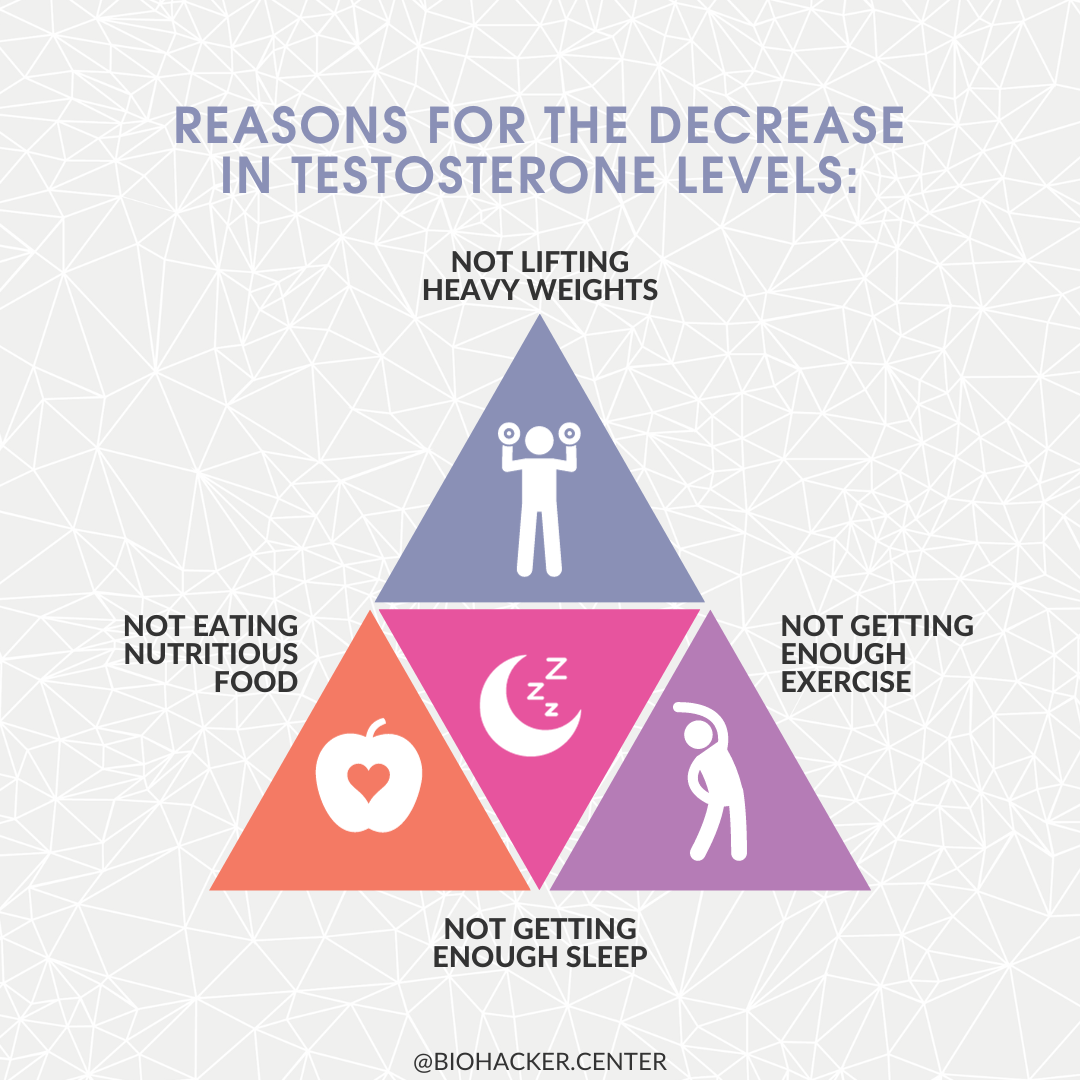
Lifestyle factors increasing testosterone levels include:
- Sufficient, high quality and regular sleep
- Normal body weight and waist circumference
- Strength training and muscle mass
- Stress management and meditation
- Sufficient intake of micronutrients from food (including magnesium, selenium, zinc, iodine, boron)
- Certain food groups (see the list below)
- Adequate (but not excessive) energy supply
- Adequate hydration
- Regular sex (approximately once per week is optimal)
- Avoiding hormone-disrupting chemicals (BPA, BPS, phthalates, parabens, etc.)
- General physical activity – avoiding excessive endurance training
- Increasing the density of androgen receptors
- Intermittent fasting (do not start if highly stressed or chronically fatigued)
- Explosive resistance training
- L-carnitine
- Creatine Monohydrate
- Keeping the testicles cool (avoiding heat, loose clothing, exposure to cold)
- Taking boron as a dietary supplement may increase free testosterone
- Adequate iodine intake from food
Other nutritional factors and foods affecting testosterone production:
- Sufficient protein intake (1.4–2.0 g/kilogram of body weight/day) – the harder the training, the higher the requirement
- Adequate fat intake from food (emphasis on monounsaturated and saturated fat, minimum 40 % of energy supply)
- There are varying results in terms of carbohydrate intake—some individuals do well with carbohydrates, others thrive on a low-carb diet
Nutrient-dense foods promoting testosterone production include:
- Grass-fed meat (mutton, lamb, beef)
- Game
- Organic potatoes (if carbohydrates are included in the diet)
- Grass-fed butter
- Cold-pressed virgin olive oil
- Avocados
- Dark green vegetables and herbs
- Organic eggs
- Red onion and other onions
- Dark berries
- Raw and dark chocolate
- Pomegranate seeds
- Brazil nuts
Biostarks reference ranges for total testosterone
- Men: Total Testosterone (TT-S): 260-920 ng/dL
The optimal level for men is in the top half of the reference range – the closer to the upper limit, the better. Levels below 400 may be indicative of subclinical hypogonadism, which requires treatment.
- Pre-menopausal: Approximately 15 to 70 ng/dL
- Post-menopausal: Approximately 30 to 50 ng/dL (ranges can be lower, and vary based on years since menopause and whether the woman is on hormone replacement therapy)
Scientific references:
- Laughlin, G. A., Barrett-Connor, E., & Bergstrom, J. (2008). Low serum testosterone and mortality in older men. The Journal of Clinical Endocrinology & Metabolism, 93(1), 68-75.
- Rone, M. B., Fan, J., & Papadopoulos, V. (2009). Cholesterol transport in steroid biosynthesis: role of protein–protein interactions and implications in disease states. Biochimica et Biophysica Acta (BBA)-Molecular and Cell Biology of Lipids, 1791(7), 646-658.
- Page, S. T., Mohr, B. A., Link, C. L., O'donnell, A. B., Bremner, W. J., & McKinlay, J. B. (2008). Higher testosterone levels are associated with increased high‐density lipoprotein cholesterol in men with cardiovascular disease: results from the Massachusetts Male Aging Study. Asian journal of andrology, 10(2), 193-200.
- McQuaid, J. W., & Tanrikut, C. (2014). Physiology of testosterone production. In Men's Sexual Health and Fertility: A Clinician's Guide (pp. 31-43). New York, NY: Springer New York.
- Gupta, S. K., Lindemulder, E. A., & Sathyan, G. (2000). Modeling of circadian testosterone in healthy men and hypogonadal men. The Journal of Clinical Pharmacology, 40(7), 731-738.
- Livingston, M., Kalansooriya, A., Hartland, A. J., Ramachandran, S., & Heald, A. (2017). Serum testosterone levels in male hypogonadism: Why and when to check—A review. International journal of clinical practice, 71(11), e12995.
- Jia, H., Sullivan, C. T., McCoy, S. C., Yarrow, J. F., Morrow, M., & Borst, S. E. (2015). Review of health risks of low testosterone and testosterone administration. World Journal of Clinical Cases: WJCC, 3(4), 338.
- Giannetta, E., Gianfrilli, D., Barbagallo, F., Isidori, A. M., & Lenzi, A. (2012). Subclinical male hypogonadism. Best practice & research Clinical endocrinology & metabolism, 26(4), 539-550.