Stress and recovery measurement tools
MEASURING RECOVERY
The changes in the body caused by exercise only become beneficial with sufficient recovery time. Excess physical (and mental) stress and insufficient recovery time can easily lead to overreaching. On the other hand, if the objective is to develop various physiological properties, temporary overreaching is necessary as long as it is paired with sufficient recovery time. Recovery assessment is therefore important, particularly for individuals with training goals.
Objective tools for monitoring recovery:
- Heart rate variability (HRV)
- Sleep quantity and quality
- Resting heart rate
- Distinct increases in the resting heart rate are indicative of impaired recovery speed
- Heart rate recovery after exercise – X percent in Z minutes
- Bodyweight
- Rapid loss may be indicative of excess fluid loss
- Reaction time test
- Slower reactions are indicative of the impaired recovery speed of the nervous system
- Orthostatic test
Subjective tools for monitoring recovery:
- Appetite
- Severity and duration of muscle soreness (DOMS)
- General energy level
- Measuring the sensitivity of the nervous system, for example, jump testing to a specific height
- General well-being
- Mood (POMS questionnaire)
Factors affecting recovery:
- The amount and intensity of exercise
- General nutritional state (food quantity and quality)
- General health and illnesses
- Sleep quantity and quality
- Rest and relaxation
- Muscle care
- Various medications
- Alcohol use
- Jet lag
- High altitude
- Adapting to a new climate
- Work-related stress factors
- Social stress factors
- Emotional stress factors
MEASURING HEART RATE VARIABILITY (HRV)
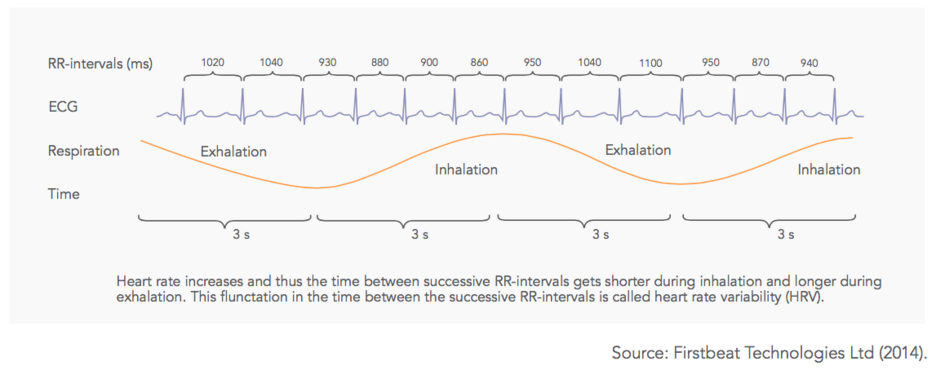
Heart rate variability (HRV) is a normal physiological phenomenon. Heart rate is not constant. The interval between heartbeats varies based on factors such as breathing (respiratory sinus arrhythmia, see image). On inhalation, the frequency is usually slightly higher (sympathetic reflex), while exhalation (parasympathetic reflex) is lower. The range of HRV is a good indicator of the functional state and dynamics of the autonomic nervous system and heart-brain interactions.
HRV increases when the body is in recovery or the individual is relaxing. Conversely, it decreases when the body is under strain (such as under stress). HRV can change significantly depending on the situation. HRV variability peaks in young adults (15–39 years of age) and begins to taper off as we age.
Factors affecting HRV:
- Breathing
- The reactions and functional state of the autonomic nervous system
- Stress reactions
- Hormonal reactions
- Relaxation
- Metabolic processes
- Physical activity (exercise and recovery)
- Movements and changes in posture
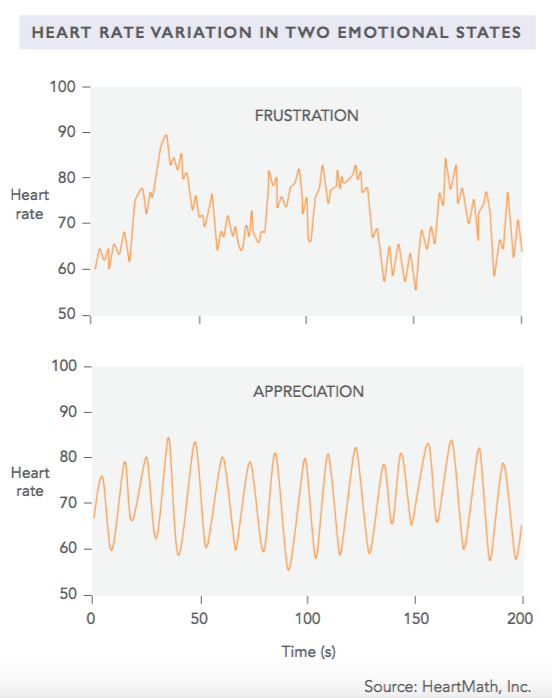
- Thinking and emotional reactions (general psychological stress)
- Alcohol use and nutrition
Measuring HRV over 3–7 days is an excellent way to examine the stress caused by the workday and other activities, recovery during the workday and recovery overnight. HRV may also be measured using various sensors that can be worn or placed under the bedsheets to monitor long-term recovery.
A higher heart rate variability is associated with better cognitive and emotional flexibility, especially in extreme emotional states. People with high HRV can control their feelings better than those with low HRV. People with low HRV respond to normal stimuli as if they were harmful or threatening.
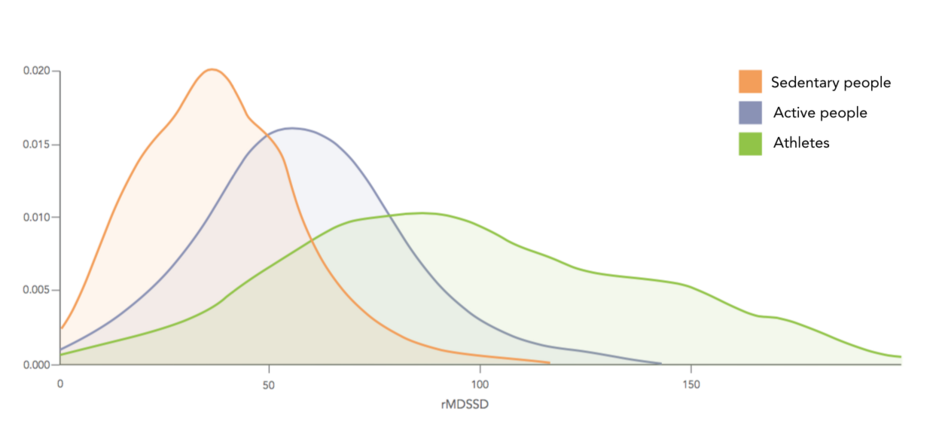
Devices measuring heart rate variability usually give a numerical interpretation based on rMSSD. You can customize your habits and operating patterns by following this change in value daily and comparing these changes to, for example, the previous day and week load conditions. Long-term pain has been shown to decrease HRV - many patients with fibromyalgia have a moderately reduced HRV level, suggesting an overactive sympathetic nervous system and correspondingly reduced parasympathetic nervous activity.
Acute illness and fever also lower the heart rate variability, usually because the resting pulse rises clearly (mostly over ten strokes per minute). In many cases, the HRV level is already clearly reduced before the disease. Based on this, changes in HRV levels can be followed by rest and stress management to reduce the risk of illness, for example, in seasonal flu.
Long-term measurement of heart rate variability (3–7 days) is a great way to determine how the workload, exercise, or other activity is associated with recovery. Heart rate variability can also be measured using various types of wearable devices (such as a wristband, heart rate belt, or a ring) and, for example, a pad put under the mattress. Such devices allow the monitoring of long-term recovery.
What is rMSSD
rMSSD stands for Root Mean Square of the Successive R-R Differences. This means a mathematical value derived from R-R intervals, representing the average fluctuation of successive heart rate intervals in milliseconds. Higher-than-normal readings indicate high parasympathetic arousal activity and increased heart rate variability (HRV). Correspondingly, lower than-normal readings indicate reduced parasympathetic nervous activity and reduced heart rate variability.
It is usually sufficient to measure a few minutes for a reliable rMSSD. It can be performed anywhere and does not require a special breathing rhythm during the measurement. Usually, a precise wireless heart rate belt is needed to make a measurement. For example, measurement can also be used while traveling and in other situations away from home. It is best suited for daily stress monitoring and autonomic nervous system balance.