Sodium intake & salt
SODIUM (SALT) INTAKE FROM FOOD
The official minimum intake guideline for sodium in Finland is approximately 1.5 grams per day. The population-level guideline for the maximum salt intake for adults is up to 5 g/day, which is the equivalent of 2 g/day in sodium.
The average salt (NaCl) intake for adult Finnish men (aged 25–64) is 8.9 g per day (3.5 g of sodium) and for adult women (aged 25–64) it is 6.5 g per day (2.6 g of sodium). Based on the FinRavinto 2012 study, the recommendation for men is less than 7 g/day (Na 2.4 g) and for women less than 6 g/day (Na 2.8 g) (cf. current guideline of 5 g/day). The results suggest that Finns consume sufficient (often excessive) salt (NaCl) compared to the guidelines.
It is worth noting that although excessive salt intake (more than 6 g/day) is linked to high blood pressure, low salt intake (less than 3 g/day) is an even greater health risk. Another important factor is that Finns consume too much poor-quality, refined table salt lacking in other minerals. Some individuals are more sensitive to salt than others. According to estimates, approximately 26 % of individuals with normal and 51 % with high blood pressure are sensitive to salt.
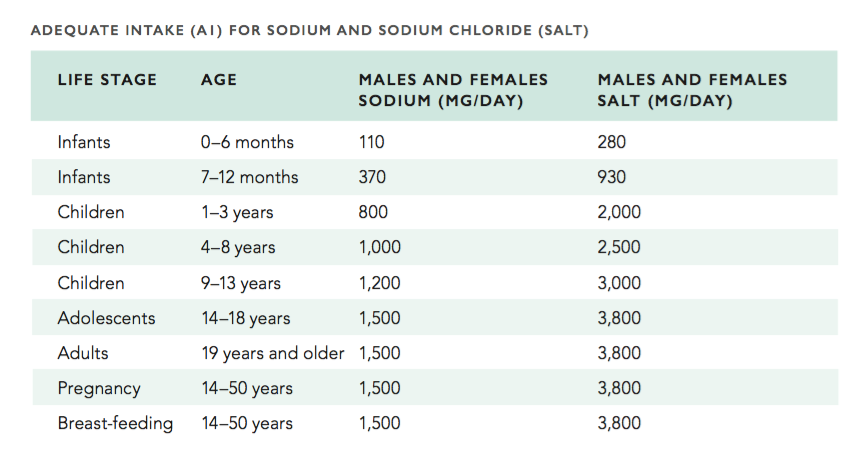
In the United States, the recommended dietary allowance (RDA) for salt has been up to 5.8 g/day (the equivalent of 2.3 g of sodium). According to studies, guidelines that are lower than these are not helpful and may even be harmful to people with diabetes, kidney disease, or cardiovascular disease. In 2019, the Food and Nutrition Board (FNB) of the National Academy of Medicine revised the Dietary Reference Intakes (DRIs) for sodium. The FNB did not find sufficient evidence to determine an Estimated Average Requirement (EAR) and derive a Recommended Dietary Allowance (RDA). Instead, they established an adequate intake (AI) for sodium.
Summary
On average, people, in general, consume too much poor-quality salt (hidden salt, added refined salt) and not enough mineral-rich salt. You can consume too much salt, or not enough. Excessive salt intake and insufficient potassium intake can harm your health.
Upgrade your salt to a high-quality one (see the chapter's end). Consume plenty of vegetables, berries and fruits to secure optimal potassium intake.
MEASURING SODIUM LEVELS IN THE LABORATORY
The body-sodium balance is primarily measured from the blood (plasma or serum). Sodium secretion can be assessed by measuring sodium levels in the urine. The sodium in the urine depends on sodium (salt) intake from food. Higher amounts are secreted when the food is high in sodium or in the event of damage to the renal corpuscle, adrenal gland deficiency, or diuretics. If there is little sodium in the urine despite normal sodium intake from food, the finding may suggest low sodium levels in the body.
Typical reference range (serum sodium):
- Adults: 137–145 nmol/L