Sleep stages & tracking
Optimize sleep stages – the secret to sleep better
There is a saying that "ignorance is bliss". Or that more information creates more pain. But with deep understanding and apprehension, the information becomes useful and actually can help with the subject at hand. Many people have no idea how they sleep and what sleep actually is.
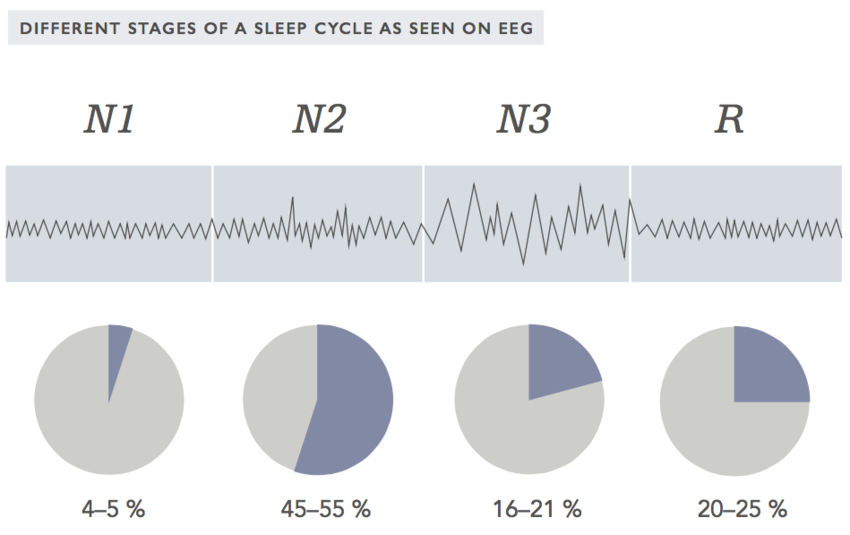
Sleep alternates between two phases: orthodox sleep and REM sleep. These phases can be distinguished from one another in EEG (electroencephalography). Most sleep is orthodox sleep (deep sleep, quiet sleep, slow-wave sleep) that can be further divided into three NREM (non-rapid eye movement) stages: N1, N2, and N3. These are in contrast to REM sleep, or R sleep (paradoxical sleep, rapid eye movement sleep).
UNDERSTANDING THE SLEEP STAGES
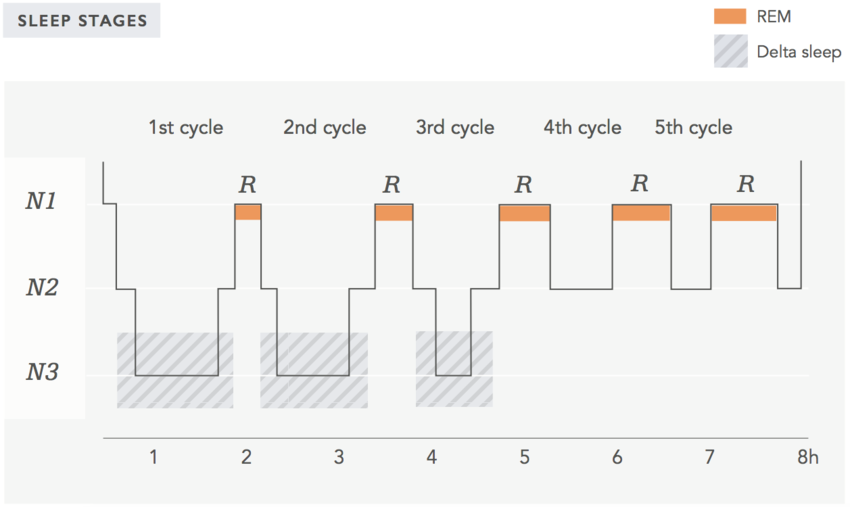
During a typical adult’s 7 to 8-hour sleep, the sleeper moves from the first stage to the second and the third stage, then back to the second stage. After this, the sleeper either wakes up or goes straight to REM sleep. From then on, the cycle repeats itself some 4–5 times.
One full cycle lasts about 90 minutes. From the perspective of getting a good night’s sleep, maximizing the amount of deep sleep (N3) by going through at least three cycles is paramount. Getting enough sleep reorganizes one’s memory and improves one’s learning capacity. In the later cycles, the amount of REM increases and deep delta sleep decreases until the latter eventually disappears.
W – Wakefulness (beta waves): infrequent and low-frequency beta waves predominate in the EEG.
Meditative state with one’s eyes closed:
Increasingly synchronized alpha and theta waves are visible in EEG, along with Increased production of serotonin. Several proven health benefits have been observed while using techniques such as meditation to increase one’s alpha and theta waves.
N1 – The first stage (theta waves, 4–8 Hz):
EEG shows irregular oscillations. Theta waves are slower and higher in frequency than alpha waves. This is a transitory phase from wakefulness to light sleep. The sleeper changes position frequently and is in a deep meditative state. However, if someone were to wake the person up, they might not feel like they had fallen asleep. Duration: about 10 minutes.
N2 – The second stage (sleep spindles, 11–16 Hz):
A period of light sleep, during which there is little movement and the breathing is quiet. The second stage involves periodic surges in brain wave frequency, the so-called sleep spindles. Brain activity during the second stage is more active than in the first stage. Dreaming becomes possible. Getting enough stage two sleep improves motor skills. The person can still be easily woken up during this stage. Duration: 20 to 30 minutes.
N3 – The third stage (delta waves, 0–8 Hz):
A period of deep sleep, where breathing is stable and EEG readings consist of slow delta waves. Muscles are completely relaxed, and the pulse, body temperature, and blood pressure have decreased. Production of human growth hormone begins, and the body's regenerative mechanisms are activated. The sleeper will not wake if another person walks into the room. Pulse, blood pressure and body temperature are at their lowest. Duration: 30 to 40 minutes. Elderly people experience a shorter duration, by as much as six minutes.
R – REM Sleep (alpha and beta waves):
During REM sleep, the brain is awake, but the rest of the body is asleep. The muscles in the neck and the body are paralyzed to prevent sleepwalking. During REM, the eyes are moving under the eyelids, and dreaming is at its peak. The typical adult has an average of 4 to 5 REM stages every night. The first stage lasts about 10 minutes, while subsequent stages are often longer, around 30 minutes. REM sleep is important for the regeneration of the brain’s nerve cells. Tests measuring the effects of sleep deprivation have shown that REM sleep is absolutely indispensable as deprivation leads to irritability, fatigue, memory loss and reduced capacity for concentration. Infants experience a lot of REM sleep: On average 50 % of the total 16 hours of sleep per night is REM sleep.
MEASURING AND TRACKING SLEEP
In 1968, Dr. Allan Rechtschaffen and his colleague Anthony Kales co-published the iconic A Manual of Standardized Terminology, Techniques and Scoring System for Sleep Stages of Human Subjects. Right up to the present day, this has been the primary source for describing the various stages of sleep.
In the last ten years, technologies for measuring sleep have escaped sleep research laboratories and fallen into the hands of consumers. A modern self-optimizer, using affordable consumer products, can collect a lot of data from his or her sleep.
TIPS FOR MEASURING SLEEP
There are many consumer products available for measuring sleep:
- Activity trackers and watches with a sleep-tracking function
- Wearable jewelry such as smart rings and pendants with a sleep-tracking function
- Sleep trackers that sense body movements during sleep using radio waves
- Sleep trackers that are placed under the bedsheets
- Sleep applications that utilize the motion sensors of a smartphone
- Sleep trackers fastened to the head that sense eye movements or electroencephalogram signals
- Heart rate belts that measure sleep quality
Adding a separate sensor to track the heart rate, body temperature and respiratory frequency significantly improves the measuring accuracy. Sleep trackers are available that use electroencephalograms; these may be even more accurate.
It is possible to start tracking sleep simply using a smartphone application although their accuracy is quite poor compared to devices designed specifically for the purpose. Regarding user convenience, trackers placed under the bedsheets, smart rings and contactless body movement sensors are the least likely to cause sleep disruptions.
Activity trackers, heart rate belts and various headgear may be uncomfortable to use as they disrupt optimal blood flow. If you are concerned about electromagnetic radiation, choose a device not placed directly on the skin that can be switched to flight mode at night. Choosing a Bluetooth device with a short range (0.5–1.0 mW) is smart regarding the electromagnetic radiation risk. 
SLEEP QUALITY GOALS
- REM sleep represents 20–25 % of the time spent asleep
- Deep sleep represents 10–20 % of the time spent asleep
- Sleep for at least 7–8 hours per night
- Falling asleep quickly (in less than 15 minutes)
- Little to no waking up during the night
- Increased heart rate variability (HRV) during the night, indicating the activation of the parasympathetic nervous system (RMSSD)
- Heart rate variability’s HF component is sufficiently high (HF increases during the activation of the parasympathetic nervous system)
- Daily resting heart rate (HR) in the morning is constant or decreasing compared to the monthly average
- Little to no snoring
- No unusual restlessness or movements during the night
- The soundscape during the night contains nothing that stands out
It is not always possible to get enough sleep – traveling or a busy work schedule may mean reduced hours of sleep. When this is the case, pay special attention to the recovery of the nervous system (HRV), the time it takes to fall asleep and the amount of deep sleep in proportion to the total time spent asleep. If the morning resting heart rate begins to creep up, try to organize rest days to boost recovery.