Optimize memory & decision-making
OPTIMIZE YOUR WORKING MEMORY
“Neurons that fire together wire together.”
– Donald Hebb
The word “memory” is derived from the name Mnemosyne, the Ancient Greek god of memory. Memory function has been studied for more than a century, yet it remains one of biology's greatest mysteries. Spanish professor of neuroanatomy and 1906 Nobel laureate Santiago Ramón y Cajal (1852–1934) discovered the neuron (nerve cell) and developed an interest in the connections between such cells.
Memory refers to the process of encoding, storing and retrieving information. The aspects of memory are usually referred to as sensory, short-term working, and long-term. Short-term and working memory are sometimes separated into distinct memory systems, although they frequently work together.
The brain areas related to memory function, in particular, are the hippocampus, cortex, amygdala, basal ganglia, mammillary bodies, and cerebellum. The hippocampus is crucial in processing and storing memories. It receives impulses from various parts of the cortex and forwards them to other brain areas.
SHORT-TERM WORKING MEMORY
As its name implies, working memory represents the information storage currently used for work or other activities. It is activated when the individual is making deductions, thinking, studying, solving problems or retrieving information from long-term memory for immediate use.
Working memory may be distinguished from short-term memory using neural subsystems. When working memory is functioning, the dorsolateral prefrontal cortex activates. It is not active when memory information is not being processed (i.e. when it has not been moved to working memory).
There are several theories regarding working memory function. One of the most frequently cited theories is Baddeley's model of working memory (1974). It has been widely criticized for its complexity – yet it has proven useful when studying working memory.
Engle's two-part memory model is a simpler explanation of working memory function. It divides working memory into two parts: primary and secondary memory.
Primary memory maintains the information being used while secondary memory retrieves information from elsewhere in memory. According to Engle’s model, individual differences in memory function can be explained by the ability to stay focused on information, the ability to ignore the stimuli that interfere with one’s concentration and the ability to retrieve information from long-term memory.
The capacity of working memory has been previously estimated to be 5–9 information chunks; more recently, it has been claimed that the real figure is 3–5 information chunks. The duration of working memory is estimated to be less than 20 seconds. However, it is possible to extend this time by repeating the items to be memorized.
Try these methods to develop optimal working memory
- Meditation
- The so-called “brain training” programs may help develop working memory although there is conflicting research
- Regular physical activity helps to maintain proper working memory
- High-intensity maximal or interval training (especially four hours after a learning process)
- Barefoot running
- Yoga
- Listening to tonal (harmonious) music – fast classical music in a major key activates working memory and boosts processing speed, particularly in the elderly (the Vivaldi effect)
- Transcranial direct-current stimulation (tDCS)
- Dual N-Back training may improve working memory (controversial findings)
- Creatine monohydrate
- Caffeine and L-theanine
- Panax ginseng and Bacopa monnieri
- Nicotine (spray or gum)
- L-tyrosine
- Turmeric and curcumin
- Phosphatidylserine
OPTIMIZE LEARNING & READING
Before beginning to learn and/or read something, you want to make yourself clear on a few important goals and answer these questions:
- Why am I reading this?
- What do I want to take away from this?
Never read anything without a clearly defined goal. Consider also changing reading speed when something unimportant or highly important is read.
When doing a reading, you want to consider various factors to optimize the reading experience and learning. These are:
PREPARATION
- The importance of proper light (full-spectrum light or natural light improves reading efficiency)
- If you read on a computer, using 2–3 monitors increases efficiency
- Optimize the light output of the computer screen
- Maximize your reading speed by identifying the optimal recognition point (ORP). It is usually located slightly to the left of the middle of each word.
ACTUAL READING
- Set the correct reading position
- When you wish to speed read, sit at a table and place the book at a 45-degree angle
- Review the table of contents
- Quickly preview and leaf through the book
- Images, tables, graphics, and special sections
- Read efficiently, avoiding unnecessary eye movements (focus your eyes in the middle of the line)
- Using a pen or the reader's highlighting functionality, underline or highlight important content so that you can easily review it
- Take a photo of the underlined sections or cut them on a computer and paste them into a new notes document
- Review the underlined sections several times and reduce the reading speed for each iteration.
- In terms of learning, writing notes manually is more effective than typing them on a computer
OPTIMIZE THE RESULTS AFTER READING & LEARNING
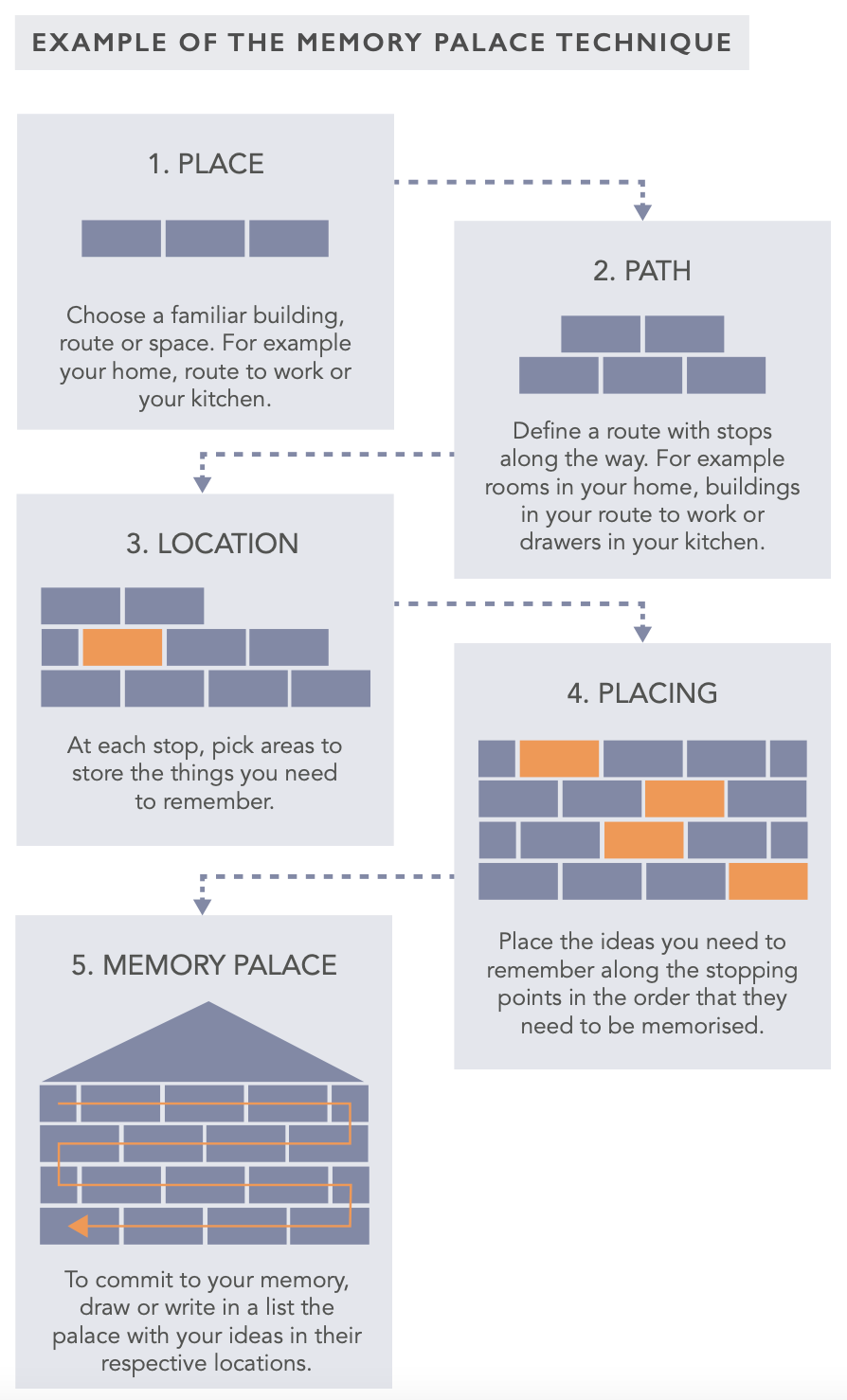
- Visualize what you just learned and connect it to the larger visual whole. You may utilize for example the Memory Palace technique (see picture below) in which you split your body or house into ten points. Visualize connecting the things you have learned to various points in order.
- To help remember the numbers, create an item for each number in your mind. Learn the numbers by recalling the items in a specific order.
- Take a nap. It increases the likelihood of remembering.
- Review your notes every few weeks. Repetition increases the volume of gray matter in the brain associated with information processing.
- Try to teach what you learned to someone else. If you cannot find a suitable subject, write an article or make a video. 50 % of the time should be spent consuming (e.g. reading) and the other 50 % producing (e.g. writing).
OPTIMIZE YOUR DECISION-MAKING
”If it's not a hell yes, it's a no.” – Derek Sivers
Decision-making is a cognitive process where a choice is made between several options. Decision-making can be examined from the individual's values and needs. On the other hand, these values are determined by the individual's worldview.
The decision-making process is a continuum integrated into stimuli from the surrounding environment. The more environmental stimuli there are, the more decisions (conscious or unconscious) must be made each day. Dutch psychologist Ap Dijksterhuis (b. 1968) is the father of the Unconscious Thought Theory. According to his theory, most decisions requiring complex reasoning are unconscious (subconscious).
The conscious mind usually makes decisions regarding simpler matters. If the rational, conscious mind were forced to analyze the pros and cons of every decision, we would very quickly become fatigued. Sometimes people are paralyzed by the multitudes of options available and unable to make decisions. This is called analysis paralysis.
Having too much information available may reduce the probability of an actual decision being made. Fatigue and confusion may also be the end result of what is known as decision fatigue. In such cases, the capacity of the brain and the mind to make decisions is exceeded.
The ability to make a decision between emotion and reason often determines whether the individual procrastinates or reaches a decision. From the biohacker’s viewpoint, the decision-making process is of utmost importance. An individual's decision-making process often involves prejudices and outright illusions that may influence the outcome. They are also called cognitive biases, or tendencies to think in a particular way.
Becoming aware of your cognitive biases is helpful when considering various options while making a decision. Cognitive biases include the following:
- Selective perception
- Confirmation bias
- False-consensus effect
- Cognitive inertia (the inability to see perspectives other than one's own)
- Conservatism bias
- Information bias
- Recency illusion
- Clustering illusion
- Bandwagon effect
- Blind-spot spot
- Anchoring (attachment to the first source of information)
- Cognitive ease/strain (susceptibility to believe claims expressed with simpler words)
- Priming (suggestions that direct the attention to information repeated later on)
- Intuitive heuristics (choosing the easiest solution to a difficult problem)
Nobel laureate and psychologist Daniel Kahneman, who specializes in decision-making and behavioral sciences, writes in his book Thinking, Fast and Slow (2011) about two distinct systems through which individuals usually form their opinions:
- System 1: fast, automatic, emotional, stereotypical, subconscious
- System 2: slow, analytical, logical, calculating, conscious
According to Kahneman, we spend most of the time with our behavior and decision-making being controlled by System 1. System 2 requires more effort and activating it consumes more energy.
Decision-making process suitable for knowledge work or studying
This model has been created by scientists and validated in multiple studies.
- Identify the decision you want to make
- Gather the information necessary for the decision
- Identify various alternatives
- Weigh and assess the evidence associated with the alternatives
- Make a selection between the alternatives
- Act per the decision made
- Review the decision and its significance – is there a need for a new decision?
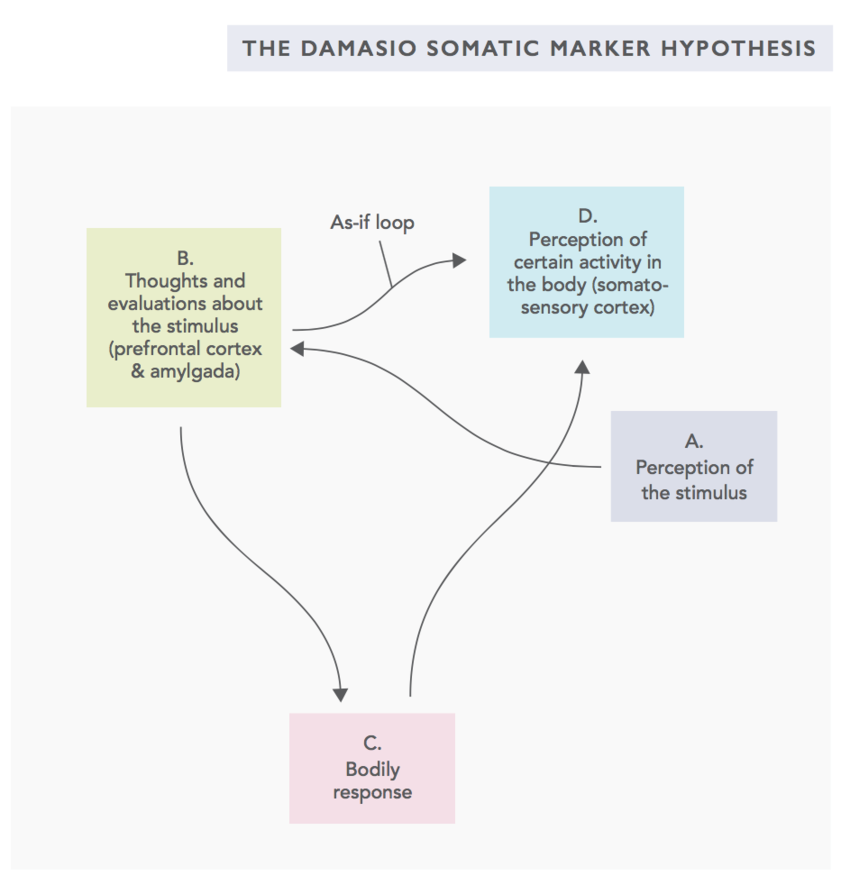
The somatic marker hypothesis
The somatic marker hypothesis involves the impact of emotions on decision-making from the viewpoint of neurobiology. According to the hypothesis, various emotions create physical feelings that potentially distort decision-making in favor of rewards.
Loewenstein and Lerner (2003) assign emotions two-fold roles in decision-making:
- anticipating specific future emotions
- being experienced directly during the decision-making process.
People who “live in the moment” are more likely to make decisions based on their current emotional state. People who focus on the past or the future are more likely to make decisions based on a similar, previously experienced emotion or an imagined potential emotion. A decision made in the spur of a moment may indeed be very irrational and disruptive to rational, optimal decision-making.