Optimize circadian rhythms
OPTIMIZE YOUR BIOLOGICAL CLOCK AND CIRCADIAN RHYTHMS
Human beings have an internal clock that lasts about 25 hours and resets itself daily when exposed to daylight. Blind people can thus have sleeping problems, and yet, even without the ability to see sunlight, their bodies function mostly just fine.
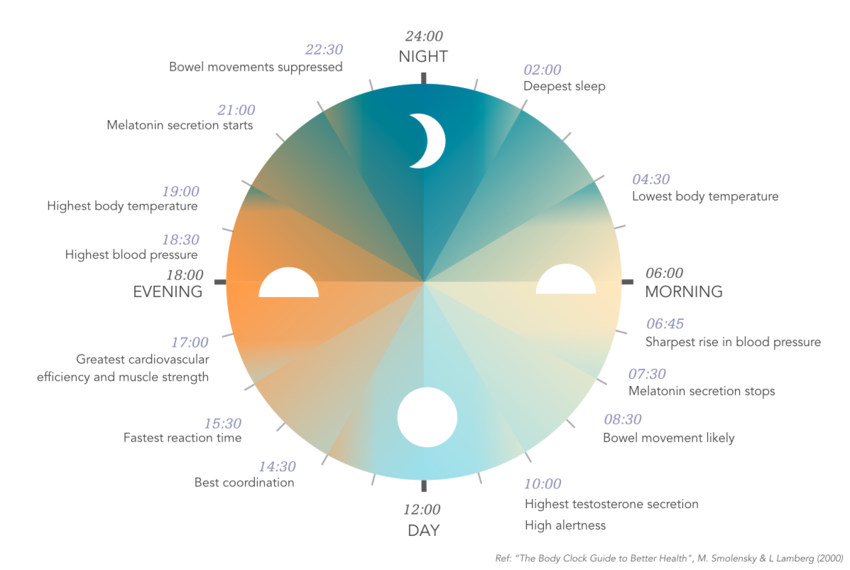
Circadian rhythms are biological processes linked to the cycles of the day. Many bodily functions vary according to these rhythms, including the following:
- Body temperature
- Pulse rate and blood pressure
- Reaction time and performance
- The production of melatonin, serotonin, and cortisol
- Intestinal activity
Light clearly has a central role in regulating our daily lives and can be used to reset our circadian rhythms. Luminosity should reach at least 1000 lux in intensity to have such an effect – compare this to the 320–500 lux in a typical office and the 32,000 to 130,000 lux in direct sunlight.
Light directly affects the production of melatonin, the so-called “hormone of darkness”, which is secreted mostly by the pineal gland during the hours of darkness. Melatonin plays a crucial role in the regulation of the sleep-wake cycle.
Light intensity isn’t the only factor in melatonin production; its wavelength also affects it. Blue light (short wavelength, around 420–485 nm) dominates during daylight, which blocks melatonin production. Research shows white LED lighting is five times more efficient at blocking melatonin production than incandescent light bulbs.
To optimize sleep, it is important to understand how other hormones influence circadian rhythms. High levels of dopamine and serotonin have been linked to alertness and adversely low levels of sleepiness. Cortisol, known as “the stress hormone,” contributes to sudden wakefulness in the middle of the night. Its production is especially active for the first 30 minutes after waking up.
TAKE HOME MESSAGE:
If your body’s biological clocks are misaligned with its circadian rhythms, it will cause more stress in the body (cellular, emotional & psychological) and predispose you to disease and bodily dysfunctions such as hormonal imbalances. This is one of the reasons that people should follow a consistent sleep schedule and align their bodies to natural light whenever possible. 
DO THESE 5 THINGS EVERY DAY
- Go to sleep at the same time every day (maximum 1-hour window, e.g. at 22–23 o'clock)
- Wake up at the same time every day (maximum 1-hour window, e.g. 7-8 o'clock)
- Get light exposure immediately after waking up (prefer Sun, if not available use bright lights minimum of 2 hours in the morning/noon)
- Avoid blue light in the evening – prefer red light
- Exercise/move daily, 20–30 mins is enough