Optimal human performance
Optimal Human Performance & Health
Optimal health and well-being as an objective presents a paradox. Due to the limited human capacity for understanding, we may never know the secret to holistic well-being or eternal life. However, with calculated guesses, comprehensive experimentation and sheer luck we may achieve exceptionally good results.
Human health cannot be approached in a reductionist manner if well-being is the long-term goal. Therefore, the secret to a better life can not be found in a pill bottle, fad diet or trendy exercise regime.
The opposite of reductionism is holism. For a long time, it was assumed that solving the puzzle of human genetics would provide answers to all questions regarding health and well-being. Instead, we have only recently begun to understand how crucial complex environmental factors (i.e. epigenetics) are in this scenario. By studying individual genes, we have evidence that their function is indeed controlled by the environment's impact on them.
Many modern individuals have health knowledge, yet few have applied their learning to practice. Scientific studies often attempt to identify the single factor determining the expected result. Even so, the theories studied and expert recommendations received remain only informed guesses until the reader tests the effects on themselves. Thus, a theory may lead to a personal experience with real practical significance.
There is no silver bullet for better well-being. In terms of developing health and well-being, the desired holistic change can only be achieved by implementing several methods simultaneously. The compound effect indicates that 1+1=3. In other words, holistic well-being does not result from a single food item, dietary supplement or drug.
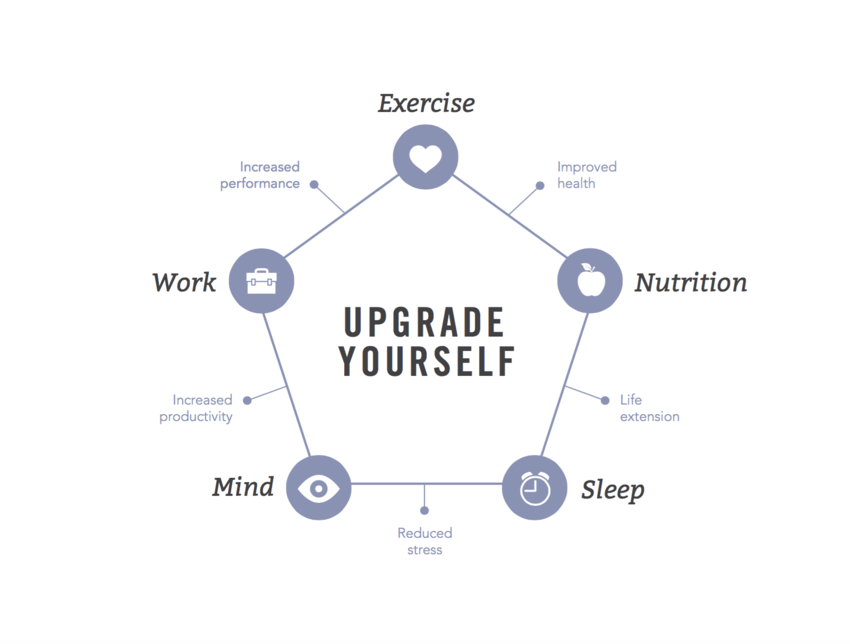
The most significant improvement in one’s well-being can be achieved as the result of interaction between several methods. This concept of the whole being more than the sum of its parts is called emergence. For example, instead of reaching for sleeping pills, one might choose to optimize his or her nutrition, exercise regime, sleep, stress management and other environmental factors.
The optimization of physiological health involves balancing both the lower levels of the system (such as nutrition, mitochondria and microbiome) as well as the higher levels (such as social relations, working conditions and the environment).
In the spirit of the Pareto principle, systems thinking can be used to identify the 20 % of the input that produces 80 % of the results.