Meditation & mindfulness
BALANCE YOUR MIND & BODY WITH MEDITATION
Meditation – as a term, word or exercise – means different things to different people. The dictionary definition states that meditation refers to certain methods of exercising the mind or attempting to achieve certain states of consciousness (Oxford, Cambridge). Meditation could also be described as introspection where the practitioner observes his/her thoughts and feelings.
Here is what the research shows about meditation:
PSYCHOLOGICAL EFFECTS
- Higher stress tolerance and lower stress levels
- Finding it easier to forgive
- Reduced anxiety and depression
- Improved ability to concentrate and better control of emotions
- Improved memory
- Increased empathy
- Improved cognitive function and intelligence
PHYSIOLOGICAL EFFECTS
- Lower blood pressure and resting heart rate as well as reduced physiological stress
- Lower levels of cortisol in the blood
- Reduced chronic pain and the sensation of pain
- Improved immunity
- Reduced oxidative stress in the body
- Increased alpha and theta waves in the brain
- Increased brain plasticity
- Slowing down the aging process of the brain and improving cerebral blood flow
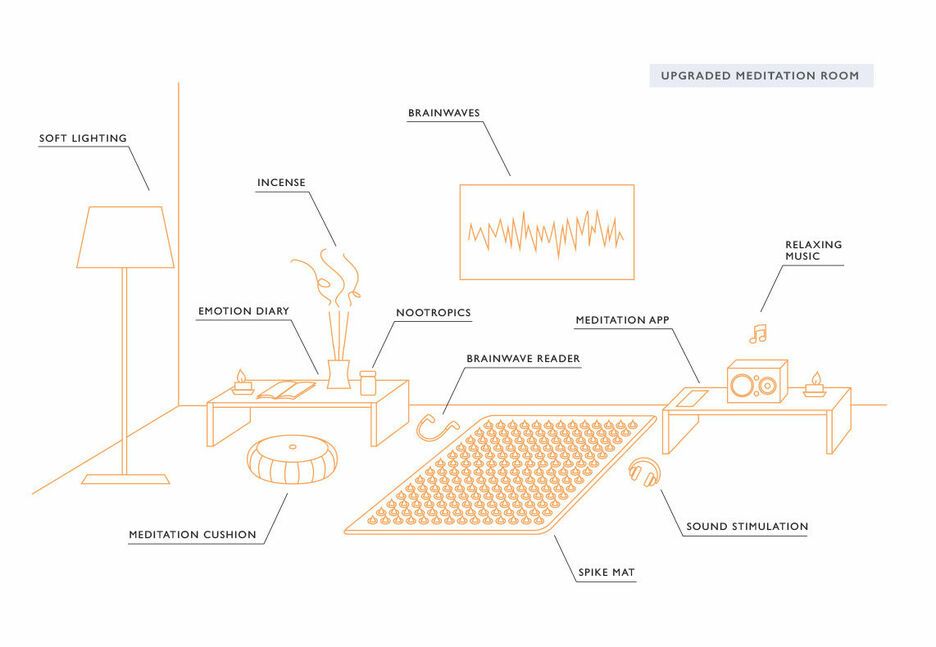
MEDITATION TECHNIQUES
Since the 1950s, hundreds of studies have been published on meditation. The most recent ones that involve brain imaging and EEG have rectified some of the methodological errors of earlier studies and deepened our understanding of the health benefits of meditation.
A comprehensive meta-analysis study published in 2012 covered 163 studies on the psychological effects of meditation. As many as 595 studies had to be excluded due to methodological issues. The most robust psychological effects have been reported in relation to emotional factors and human relationships. Slightly less robust effects have been observed in individuals’ ability to concentrate as well as their cognitive functions.
It should be noted that different meditation techniques produce different results. For example, the impact of Transcendental Meditation on cognitive skills is different compared to that of mindfulness techniques.
Mindfulness-based stress reduction (MBSR)
MBSR is a solid science-based stress-lowering and life quality-enhancing meditation technique. Professor Jon Kabat-Zinn developed it over 40 years ago to treat chronic pain patients in the hospital. The most important finding was combining controlled breathing with conscious presence and accepting the present movement and everything that is. The method is based on techniques practiced in Buddhism.
People tend to want to eliminate negative emotions as quickly as possible. In mindfulness, all emotions and feelings are accepted so that those can be investigated and on the other hand to practice non-reactivity. Usually, difficult emotions lead to rapid reactivity and action. For example with anxiety the feeling of being anxious is not the problem, but what happens after that. Observing the thoughts and sensations linked to a certain emotion already relieves anxiety and stress.
MBSR is a carefully structured and developed group program that uses meditation to relieve pain for physical, psychological and psychiatric reasons. With mindfulness, one can create a clearer sense of reality, diminish negative emotions and improve vitality and astuteness.
Health benefits of mindfulness practice are for example:
- Lower stress levels
- Lower chronic pain
- Lower neck and back pain
- Relief of functional GI disorders
- Lower blood pressure
- Lower anxiety, fear and panic
- Faster recovery from fatigue
- More stable mood
- Lower depression
Easy 3-step way to incorporate mindfulness into everyday life:
Feel your body in everyday pursuits
- Sense and feel your body while in the shower, while eating or for example while brushing your teeth
- Your mind may wonder, but when it does just gently pull it back into the present moment
Breathe deeply and slowly before getting up from the bed
- After waking up lie down a few minutes and breathe before getting up
- With every breath, feel that you are alive and smile a moment to yourself
- Get up consciously feeling your every move going into the day
Rest your brain while walking
- Walk slower and sense how walking feels
- Feel the earth beneath your feet, feel the air and temperature changes and feel every other sensation arising from your surroundings
Transcendental meditation
Transcendental Meditation (TM) is a form of meditation developed by the Indian spiritual teacher Maharishi Mahesh Yogi (1918–2008), based on Indian Vedic traditions. In the Western world, TM landed in 1958. Transcendental meditation became popular among public figures in the 1960s and 1970s.
The meditation exercise usually uses a mantra (for example, "I" or "I am" or some insignificant voice like "yymmmm") which is played out aloud or in the mind during the whole exercise with the eyes closed. Unlike many other meditation, TM does not focus on anything, but in TM moments, images and feelings are allowed to change from moment to moment. As meditation progresses, the mantra is also let go and allowed to transform into any form. When the mantra disappears, it is taken into account and returned to mind. At the end of meditation, thinking of the mantra is stopped and everything is only allowed to be before opening the eyes. The recommended time for meditation is twice a day 20 minutes.
In TM, its ease and facility are essential. The key is to be alone without identifying any particular external or internal variable such as thought, knowledge or physical phenomenon. One of TM's goals is to provide tools for self-discovery and knowledge.
More than 600 scientific studies have been published on TM, making it the most studied individual meditation technique. The health effects of transcendental meditation include, among other things, a decrease in stress levels and improved stress tolerance, anxiety relief and a decrease in blood pressure. Other health effects have also been observed, but the quality of studies is insufficient to conclude.
Loving-kindness meditation
As the name implies, loving-kindness meditation focuses on developing feelings of human kindness, warmth and benevolence through meditation. Compassion, kindness, and empathy are built in fundamental human emotions. The loving-kindness meditation has been found to increase positive emotions significantly and, on the other hand, to reduce negative emotional states. Meditation makes it easier to handle and control these daily emotions.
This method can also increase the heart rate variability (HRV) that activates the parasympathetic nervous system, which has been shown to increase well-being, and positive emotional states and strengthen social connections. This leads to an overall self-reinforcing positive spiral.
Research has shown that even focusing on such meditation effectively increases positivity and sociality. The loving-kindness meditation has been also found to have useful long-term effects.
The health effects of loving-kindness include:
- Can reduce anxiety and depression associated with post-traumatic stress disorder (PTSD )
- Can slow down aging and increase telomere length, especially in women
- Can reduce chronic low back pain
- Can reduce migraines
- Can reduce stress responses
- Can increase brain size in the limbic systemIn addition to its beneficial effects on health, loving-kindness meditation has been found in studies to alleviate self-criticality and increase empathy, compassion and the desire to help others.
Sudarshan Kriya Yoga
Sudarshan Kriya Yoga (SKY) is a breathing exercise based on traditional yoga traditions. It is taught, among other things, by the Art of Living Foundation, founded by the Indian spiritual teacher Sri Ravi Shankar (b. 1956), and is used as one of the treatments for depression. The Foundation has taught this breathing exercise to over six million people in over 150 countries.
Sudarshan Kriya (from Sanskrit: su = purposeful, darshan = vision and kriya = accomplishment) combines rhythmic and cyclic breathing that combines slow, medium and fast breathing. SKY breathing exercises have been found to relieve stress and reduce anxiety and depression.
SKY consists of four sub-categories:
- Ujjayi-breathing is performed through the nose and carried on the throat 2 to 4 times per minute
- Bhastrika breathing, where one breathes quickly in and out 30 breaths per minute pace
- Chanting of the “Om” mantra three times. At the same time, a very long exhalation is performed.
- Sudarshan Kriya (SK), consists of variable cyclic breathing with three different speeds (slow, medium and fast)
The SKY breathing exercise affects the physiology of the body in many ways:
- Ujjayi-breathing increases the function of the parasympathetic nervous system through its stimulating effect on the vagus nerve. It increases, among other things, respiratory sinus arrhythmia (RSA) and hence heart rate variability (HRV).
- Similarly, repetition of the “Om” mantra has been found to increase sensory sensitivity
- According to developers the Sudarshan Kriya -technique can improve overall perception and cleanse the body (Proper Vision by Purifying Action).
Studies have shown that SKY improves autonomic nervous system function, hormonal equilibrium, emotional processing and a sense of social cohesion.
BREATHING TECHNIQUES
Breathing and the regulation thereof have a great impact on the function of the autonomic nervous system. Deep breathing exercises are especially effective in reducing stress and tension. Extended exhalation effectively activates the parasympathetic nervous system, linked to increased relaxation and recovery and lowered heart rate and blood pressure.
For example, highly effective Pranayama breathing techniques can be used to improve stress tolerance and operational control, parasympatheticnervous system function and respiratory capacity as well as to reduce blood pressure and oxygen consumption.
TRY THESE EFFECTIVE BREATHING TECHNIQUES
The breath of fire (bhastrika)
The breath of fire is a vigorous breathing technique in which the movements of the diaphragm are used to breathe in and out through the nose. The traditional bhastrika technique involves repeating the breath sequence 10–100 times, then drawing the lungs full of air and holding one's breath for as long as possible. This is followed by exhalation through the mouth as slowly as possible, completing one bhastrika cycle. The cycles may be repeated as many times as is desired.
The breath of fire increases the oxygen saturation in the blood and improves the function of the respiratory system (particularly the diaphragm). The breath of fire balances the sympathetic and parasympathetic nervous systems.
A 10-second breathing exercise for stress relief
The breath of fire may also be utilized for quick stress relief.
- Bring your hands in front of your chest and push your palms together
- Breathe vigorously in and out through the mouth for 10 seconds utilizing your diaphragm
- Visualize stress leaving your body and fill your mind with positive thoughts
- Take a deep breath in and exhale completely after a ten-second breath of fire
The relaxing breath (visama vrtti)
The Relaxing Breath technique, developed by Dr. Andrew Weil, is based on the visama-vrtti pranayama technique, which utilizes uneven breathing patterns (for example 4–7–8). The figures refer to the ratio of inhalation, retaining the breath and exhalation as counted in the mind.
Dr. Weil noticed that this breathing pattern effectively calms the nervous system and facilitates falling asleep when treating his patients. This breathing technique may also alleviate stress and remove carbon dioxide from the body.
Alternate nostril breathing
Alternate nostril breathing is one of Western countries' most common pranayama breathing techniques. Nādī Shodhana is Sanskrit and means the purification of energy channels. Indeed, alternate nostril breathing is used in yoga to balance the body and mind.
When practiced regularly, alternate nostril breathing can lower blood pressure, respiratory rate and resting heart rate, improve heart rate variability (HRV), and balance the function of the autonomic nervous system by boosting the activity of the vagus nerve.
The exercise:
- Close the right nostril using the thumb and inhale slowly
- After inhaling, release the right nostril and close the left nostril using the ring finger
- Exhale slowly through the right nostril
- Inhale through the right nostril, release the left nostril and close the right nostril
- Exhale through the left nostril
- This completes one cycle of alternate nostril breathing; continue as directed for 10 minutes