Liver
LIVER
The liver is located in the top right corner of the abdominal cavity, immediately below the diaphragm, to the right of the stomach. Below it lies the gallbladder. Compared to other internal organs, the liver has a double blood supply via the portal vein and the hepatic arteries. This is indicative of the importance of the liver to the entire system. The liver is also a sizeable organ – it weighs on average 1.5 kg. More than 2,000 liters of blood flow through it every day.
The liver also contains the bile duct system, which collects the bile produced by the liver. Bile ducts generally refer to all ducts through which bile travels from the liver to the gallbladder and duodenum.
Main functions of the liver:
- Carbohydrate metabolism
- Produces glucose from amino acids, lactic acid, and glycerol
- Breaks down glycogen into glucose
- Forms glycogen from glucose
2. Fat metabolism
- Oxidizes fatty acids into energy
- Produces large amounts of cholesterol, phospholipids, and lipoproteins (such as LDL, HDL, VLDL)
3. Protein metabolism:
- Breaks down amino acids
- Converts toxic ammonia into urea (urea cycle)
- Produces blood plasma proteins (including albumin)
- Produces amino acids and converts them into other compounds
4. Bile secretion
- Production of red blood cells and coagulation agents
- Storing glucose (glycogen / 10% of the total weight of the liver), fat-soluble vitamins (A, D, K) and vitamin B12, iron, and copper
5. Cleaning and defense functions:
- Breaks down several hormones (including insulin)
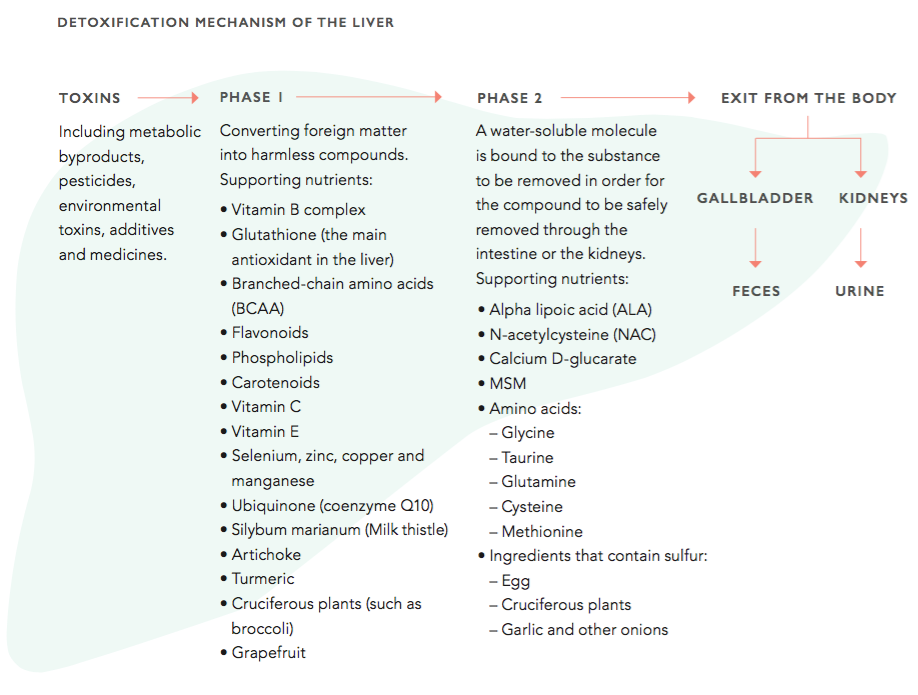
- Breaks down and neutralizes toxins (detoxification)
- Removes (through urine) bilirubin released by red blood cells
Liver disease-related mortality rates tripled between 1970 and 2010. Today's stressful work culture, alcohol use, problematic diet, and other environmental stressors have impaired liver function in many individuals.364 Abdominal obesity, in particular, contributes to the development of fatty liver disease. It has been estimated that a waist circumference exceeding 100 cm in men and 90 cm in women is a highly likely indicator of fatty liver disease. Recommended waist circumference figures are less than 94 cm for men and less than 80 cm for women. Approximately 80 % of individuals with a BMI over 30 have fatty liver disease. The most precise method of diagnosing fatty liver disease is by liver biopsy.
To determine the presence of non-alcoholic fatty liver disease (NAFLD), the so-called fatty liver index (FLI) can be utilized, factoring in the body mass index (BMI), waist circumference, blood triglyceride levels, and gamma-glutamyl transferase (GGT) levels.
The formula used to calculate FLI:
FLI = [e0.953 × ln (TG) + 0.139 × BMI + 0.718 × ln (GGT) + 0.053 × WC - 15.745/(1 + e0.953 × ln (TG) + 0.139 × BMI + 0.718 × ln (GGT) + 0.053 × WC - 15.745)] × 100
- TG = Triglyceride in blood (mg/dL)
- BMI = Body mass index
- GGT = Gamma-glutamyl transferase in the blood (U/I)
- WC = Waist circumference (cm)
Scientists have determined the following cut-off points for fatty liver disease: for men, 46.9 or greater; for women, 53.8 or greater. In practice, a value of fewer than 30 rules out fatty liver disease, whereas a value above 60 is a certain indicator of the disease. The higher FLI value in women is thought to be due to the liver-protecting effect of estrogen. According to a comprehensive review, FLI is the most precise tool for the non-invasive assessment of fatty liver disease. However, measuring the waist circumference is nearly as accurate in determining non-alcoholic fatty liver disease (NAFLD).
Various medications also have a significant role in the development of liver damage. More than 900 drugs have been reported to cause liver damage. One-half of all acute cases of liver failure are caused by various medications. Some medicinal herbal products may also be harmful to the liver.
The liver has an astonishing ability to regenerate. Indeed, it is the only internal organ that can. Even when 75 % of the liver has been destroyed, it may return to a normal state. Liver function can be supported through nutrition. This involves supporting the cytochrome P450 enzyme system, which is central to the liver detoxification function. The system consists of two distinct phases (1 and 2). Both phases must run smoothly to maintain the optimal detoxification function of the liver.