Flow state
FLOW – THE KEY TO PEAK PERFORMANCE
“You know that what you need to do is possible, even though difficult, and the sense of time disappears. You forget yourself. You feel part of something larger.”
– Mihály Csíkszentmihályi
Flow is a term coined by Hungarian-born psychologist Mihály Csíkszentmihályi (b. 1934) to describe the mental state of being in harmony with the information processed by the consciousness and one's goals. It is a time of peak emotion and performance. Flow is also called the optimal experience. A person experiencing flow is so focused on one thing that everything else is shut outside the consciousness.
WHAT HAPPENS DURING FLOW STATE?
Many top athletes have described experiencing flow or being in “the Zone” during record-breaking athletic performances. Scientists have determined that the state of flow involves a temporary decrease in activity in the brain's frontal area. As a result, the neurons of the basal ganglia light up with greater efficiency. Thus, the analytical part of the brain is put on hold while the creative sensorimotor parts take center stage.
The top priority for work efficiency is to conjure up inspiration. Flow is the result of continuously doing the things that make us feel meaningful and cause us to push the limits of our skills. A 10-year McKinsey Study (2013) shows that when in Flow, people are 2–5 times more productive, 2–6 times more creative and learn up to 5 times faster than when not in the flow state. Intelligent work happens during flow!
According to author Steven Kotler, the kindlers of flow (or triggers) can be divided into four categories: psychological factors, environmental factors, social factors, and creative factors.
Psychological triggers include:
- Concentrating intensively on one task at a time without interruptions
- A clear goal or objective
- Immediate feedback that facilitates improving performance in real-time
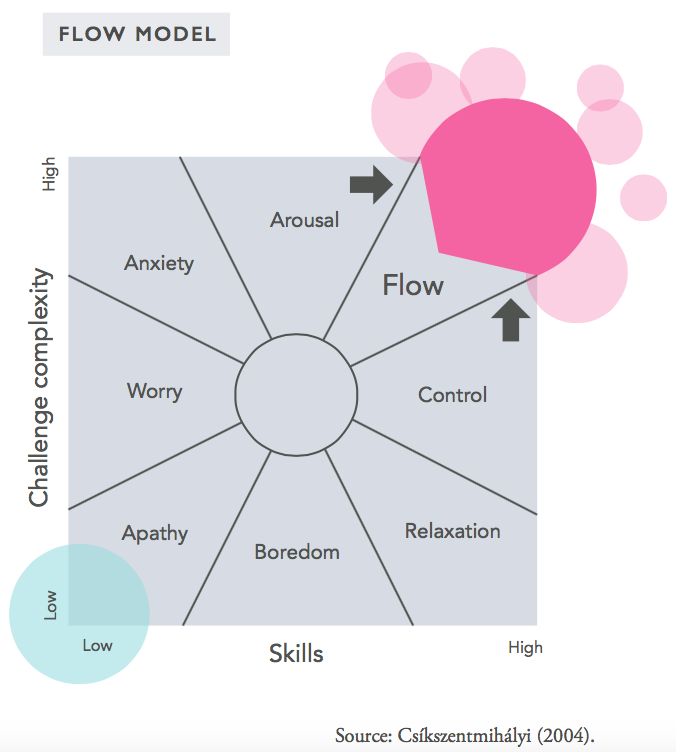
- The optimal ratio between challenge and skills (challenge slightly higher than skills)
Environmental triggers include:
- Potential serious consequences of failure (e.g. in a survival situation)
- A rich environment with plenty of new factors, surprises and uncertainty
- A deep state of embodiment
Social triggers include:
- A deeply shared state of concentration, e.g. in team sports
- Clear goals shared by the group
- Effective communication among the group
- A shared common factor (such as a language)
- A shared skill level and group participation
- A risk associated with the task boosts motivation and creativity
- The feeling of control regarding the task (the combination of autonomy and competence)
- The ability to be present and listen
- Being open to new experiences and able to say “yes”
Creative triggers include:
- Identifying repeating patterns (color, shape, data, movement, sound, concepts, risks, failure, etc.)
- Taking a risk and having the courage to present new ideas
Have you experienced a flow state? If yes, what/which was/were the trigger(s) for entering the flow state?