Exercise at Workplace
Exercise and health
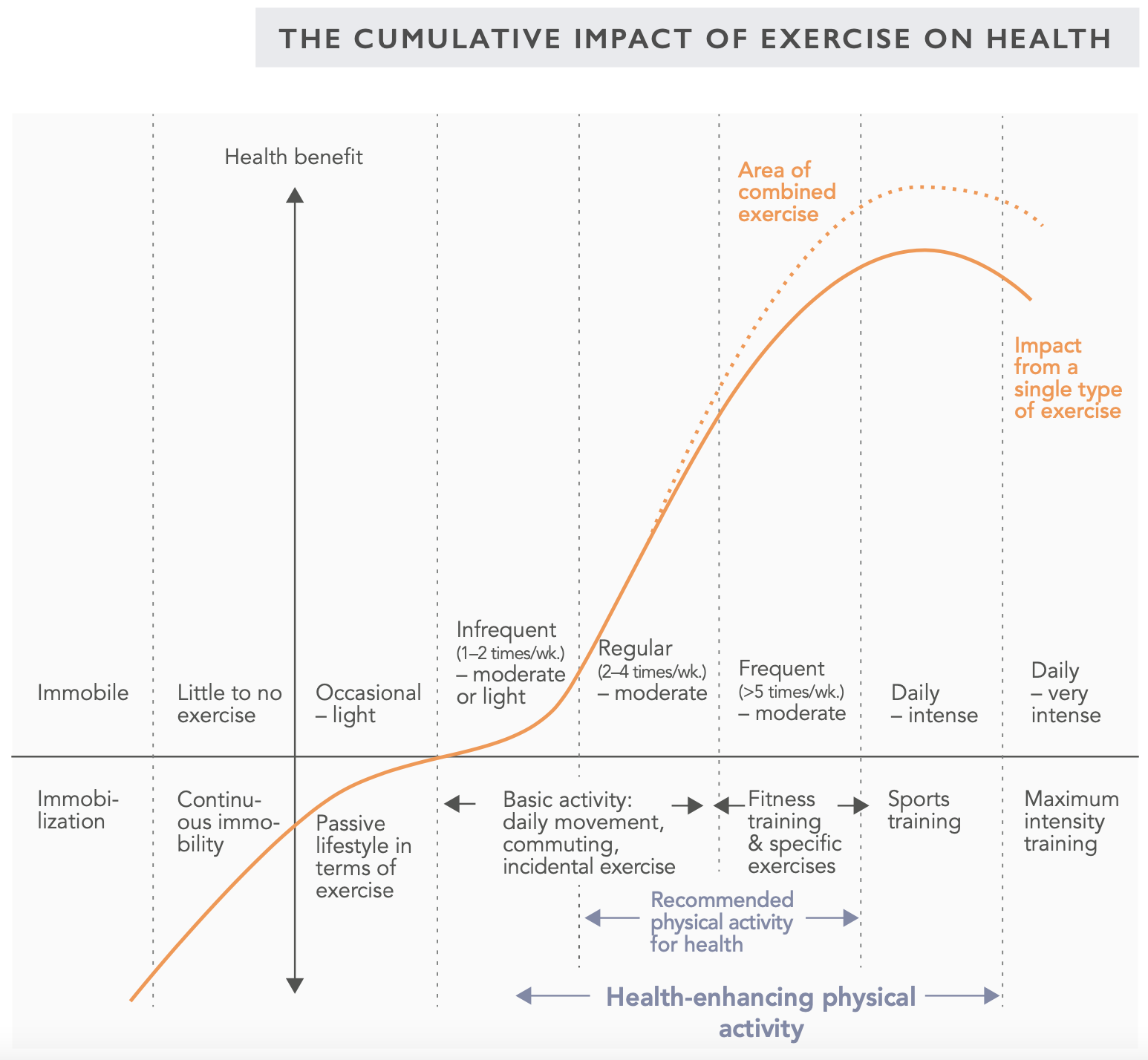
The importance of exercise to health and well-being was already known in Ancient Greece. Hippocrates (460–270 BCE) said: “Eating alone is not enough for health, there must also be exercise.” During the Renaissance, the significance of the individual's actions on his or her health became of interest. Health was no longer in the hands of God alone.
The significance of exercise to health and general well-being was understood rather early on. Proper scientific studies on the subject matter did not appear until the turn of the 20th century. The American Journal of Physiology was first published, and in 1920, physiology professor August Krogh won the Nobel Prize in medicine, having discovered the mechanism that regulates blood flow in the muscles. Research on the health benefits of exercise really took off in the 1950s when The Lancet published a groundbreaking study on the positive impact of exercise on the prevention of coronary heart disease.
The World Health Organization (WHO) has created global recommendations on physical activity for health which are based on extensive research. For individuals aged between 18 and 64 physical activity includes recreational or leisure-time physical activity, transportation, occupational, household chores, games, sports or planned exercise, in the context of daily, family, and community activities.
- Improve endurance fitness by exercising several days per week for a minimum combined duration of 2 hours 30 minutes (brisk exercise) or 1 hour 15 minutes (strenuous exercise)
- In addition, improve muscular fitness and proper form at least twice per week
- Additional health benefits may be achieved with five hours of endurance weekly exercise.
According to studies, the health benefits of regular exercise include the following:
- Lowered risk of premature death
- Lowered risk of coronary heart disease
- Lowered risk of stroke
- Lowered risk of hypertension
- Lowered risk of type 2 diabetes
- Lowered risk of metabolic syndrome
- Lowered risk of colon cancer
- Lowered risk of breast cancer
- Prevention of weight gain
- General benefit in weight loss combined with reduced energy intake
- Improved condition of the cardiovascular and circulatory system as well as muscular fitness
- Improved bone density
- Prevention of falling
- Prevention of depression
- Improved cognitive functions
Based on meta-analysis studies, behavioral rather than cognitive intervention is the most effective way to encourage people to exercise. In other words, people respond more easily to concrete experiences than intellectual facts. Examples of behavioral intervention include setting goals, self-monitoring and measuring, feedback systems, exercise prescriptions, and various challenges. This is also the key to regular movement and exercise at the workplace. Having concrete goals, self-tracking and challenges, it is easy to incorporate daily movement into the workday.
How to incorporate exercise and movement into work?
The goal is to refine his or her body to become an optimally functioning whole. This is also known as “General Physical Preparedness” (GPP). A key part of this is the balanced training of various aspects of physical performance. Because each person is an individual, the best training methods vary. However, by following certain basic principles you can minimize unnecessary effort and focus on the methods yielding the best results.
The best way you can make the most out of the working day is to implement some movement into your breaks daily. We have covered topics on how to optimize standing & sitting; next let's learn new tools for improving balance, mobility, and coordination.
Exercise could be considered a natural, playful movement throughout the day, without forced performances, grimacing, and exhaustion. The saying “grease the groove” (GTG) refers to short, almost playful exercises conducted throughout the day that place significantly less strain on the nervous system whilst yielding results along being fun.
For example, you could do a few pull-ups each time you pass under a scaffold. You could also break up the working day with intermittent push-ups, squat jumps or dashes in the stairs.
BUILD A GYM IN THE WORKPLACE
Quite many offices have their gyms, which is a great opportunity for workers to have a break and go exercise during the workday. However, many gyms lack critical and important tools to improve one's overall fitness. Usually, these gyms or exercise rooms consist of various aerobic machines, some very light dumbbells and perhaps one to three gym machines.
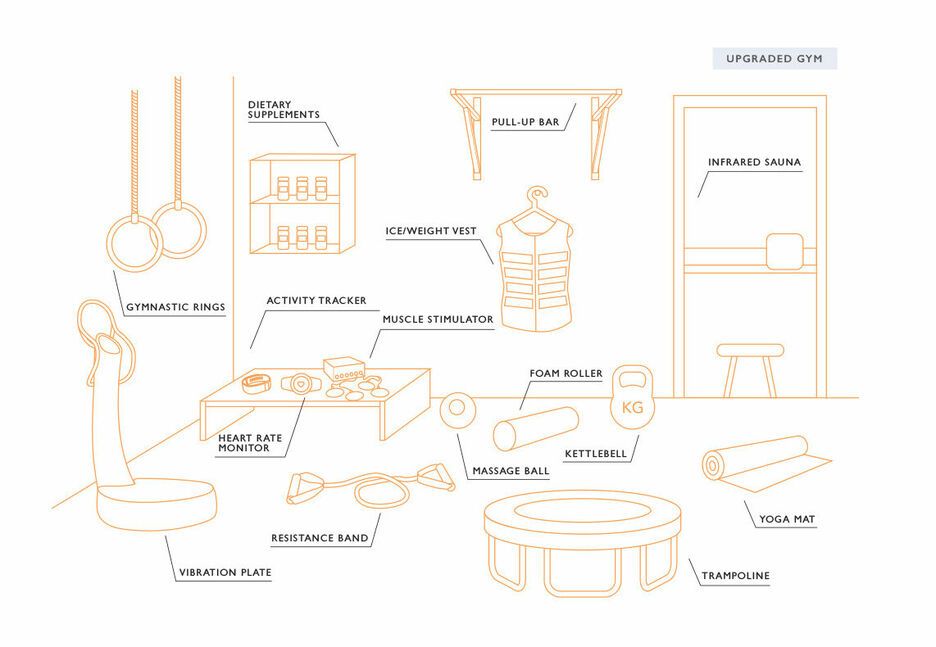
You can build a better gym into your office with minimal space available by incorporating key tools to exercise your body in multiple ways. Here is a list of key components of a workplace gym:
- pull-up bar
- squat rack (often best combined with a pull-up bar)
- one or two barbells
- wooden stick(s)
- total of 200 kg free weights (various sizes)
- gymnastic rings
- vibration plate
- resistance bands
- a few adjustable dumbbells
- foam roller
- a few kettlebells
- mini trampoline (which you can unfold when in use)
- massage balls
- bonus: one-to-two-person infrared heating room
Instead of having multiple running mats and aerobic exercise machines, if you want to practice cardio go for a walk, take stairs at intervals or do burpees.
TRY THE 7-MINUTE HIIT WORKOUT
If you have about 10 minutes and need a solid HIIT/HICT workout session that elevates your heart rate and breathing and improves your muscular endurance, the science-based 7-minute workout might be the answer.
In 12 exercises deploying only body weight, a chair, and a wall, it fulfills the latest mandates for high-intensity effort, which essentially combines a long run and a visit to the weight room into about seven minutes of steady discomfort — all of it based on science.
The following is an example of a 12-station HICT program. All exercises can be done with body weight in almost any setting (e.g., home, office, hotel room, etc.). The exercise order allows for a total body exercise to significantly increase the heart rate while the lower, upper, and core exercises function to maintain the increased heart rate while developing strength.
Exercises are performed for 30 seconds, with 10 seconds of transition time between bouts. Total time for the entire circuit workout is approximately 7 minutes. The circuit can be repeated 2 to 3 times.
- Jumping jacks [Total body]
- Wall sit [Lower body]
- Push-up [Upper body]
- Abdominal crunch [Core]
- Step-up onto chair [Total body]
- Squat [Lower body]
- Triceps dip on a chair [Upper body]
- Plank [Core]
- High knees/running in place [Total body]
- Lunge [Lower body]
- Push-up and rotation [Upper body]
- Side plank [Core]
This routine was designed at the Human Performance Institute (Orlando, FL) and the results were published in an academic journal in 2013.