Blood glucose tracking
Measuring and monitoring blood glucose levels
A constant blood sugar level is one of the critical factors for maintaining good performance levels and mental alertness. For people with diabetes, monitoring blood sugar levels is vital for health. Monitoring one's blood sugar may also be helpful for people who do not have diabetes – such as people keen to find out what factors in nutrition and lifestyle affect performance and mental alertness.
Blood sugar test strips were introduced in the 1970s. They were soon followed by devices that gave a blood sugar value using the test strips. Today, it is possible to take a quick fingertip sample and have a machine to analyze it almost instantaneously. Peripheral devices and applications designed for measuring blood sugar are also available for smartphones.
People with diabetes might now use monitors under the skin that take nearly continuous blood sugar measurements (e.g., every five minutes). These monitors warn the user when the results are too low or too high or when sudden swings in blood sugar are detected. It is possible to collect long-term blood sugar data using such devices. The latest advancement is a device that uses a laser (mid-wavelength infrared) to measure blood sugar without requiring a needle prick. According to a developer study, the device's accuracy is 84 % compared to a blood test. Various nanotechnology-based devices are also in development.
Optimal blood sugar levels and interpretation
The following recommended values are based on several studies. They can be used to determine optimal estimates of the lowest possible risk of developing diabetes, cardiovascular diseases, metabolic syndrome, etc.
The immediately preceding food intake should be considered when measuring blood sugar values. For example, individuals who follow a low-carbohydrate diet usually have a lowered tolerance for sugar, which may cause high measurement values after a high-carbohydrate meal. This should be considered when conducting an oral glucose challenge test in a laboratory setting. The recommended adjustment period is four days before the test, during which a minimum of 150 g of carbohydrates per day should be consumed.
Fasting blood sugar (fasting plasma glucose, FPG)
- Normal: 4–6 mmol/L or 72–108 mg/dL
- Optimal: 4.0–5.3 mmol/L or 72–95 mg/dL (Life Extension Foundation recommends 4.0–4.7 mmol/L or 72–85 mg/dL)
Glycated hemoglobin (HbA1C)
- Normal: 20–42 mmol/L / 4.0 % – 6.0 %
- Optimal: 20–34 mmol/L / 4.0 % – 5.3 %
- Disruptive factors may include anemia (meager result) or dehydration (excessively high result)
Oral glucose tolerance test (OGTT)
- Values taken: fasting blood sugar and blood sugar 1 hour and 2 hours after the glucose challenge (75 g)
- Normal value at 1 hour: < 10.0 mmol/L or 180 mg/dL / Optimal value: < 7.8 mmol/L or 140 mg/dL
- Normal value at 2 hours: < 8.6 mmol/L or 155 mg/dL / Optimal value: < 6.7 mmol/L or 121 mg/dL
Measuring blood sugar levels at 1 hour and 2 hours after a meal
Self-monitoring blood sugar levels during 24 hours (note that the margin of error when using a monitor intended for home use is approximately 10 %)
- Fasting blood sugar after fasting for 12 hours
- Blood sugar immediately before lunch
- Blood sugar one hour after lunch (optimal value < 7.8 mmol/L) or 140 mg/dL
- Blood sugar 2 hours after lunch (optimal value < 6.7 mmol/L) or 121 mg/dL
- Blood sugar 3 hours after lunch (optimal value < 5.3 mmol/L) or 95 mg/dL
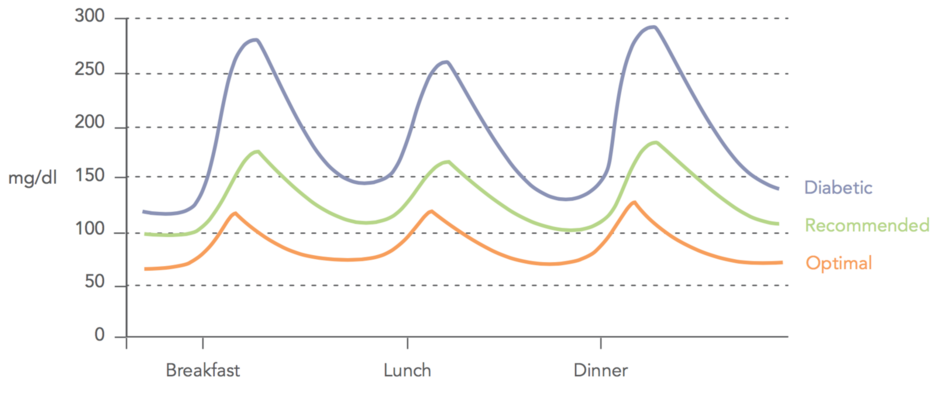
Best choice for glucose monitoring system: 24-hour continuous glucose monitoring
Continuous glucose monitoring systems are developing rapidly. Diabetics have already been able to purchase via doctor's prescription serial glucose monitoring devices for a few years now. Nowadays, the market has opened its doors for people without a disease to get a continuous glucose monitoring sensor and app for daily use.